A sudden drop can come from dozens of unrelated causes — and Amazon changes several of them silently. Product Monitor checks every lever daily, tells you the exact driver, shows what it ruled out, and learns your business every time you correct it.

Business Reports says what happened. Nothing tells you why. So sellers bounce between Seller Central, the Ads Console, Account Health, and incognito keyword checks — or ask Reddit and hope.
Category reassignment. Keyword de-indexing. AI rewriting your title without notice. Featured-Offer share quietly reduced. None of these send a notification — you find out when revenue does.
Sellers report spending days to weeks chasing a cause — three support agents, three different answers — while the real problem keeps compounding.
A paused ad is fixed in hours. Lost organic rank takes 2–6 weeks to recover.* Chase the wrong cause first and the expensive one is still running.
failure points behind a "simple" sales drop — checked on every diagnosis
separate dashboards needed to rule them out by hand
typical organic-rank recovery — the price of a wrong first guess*
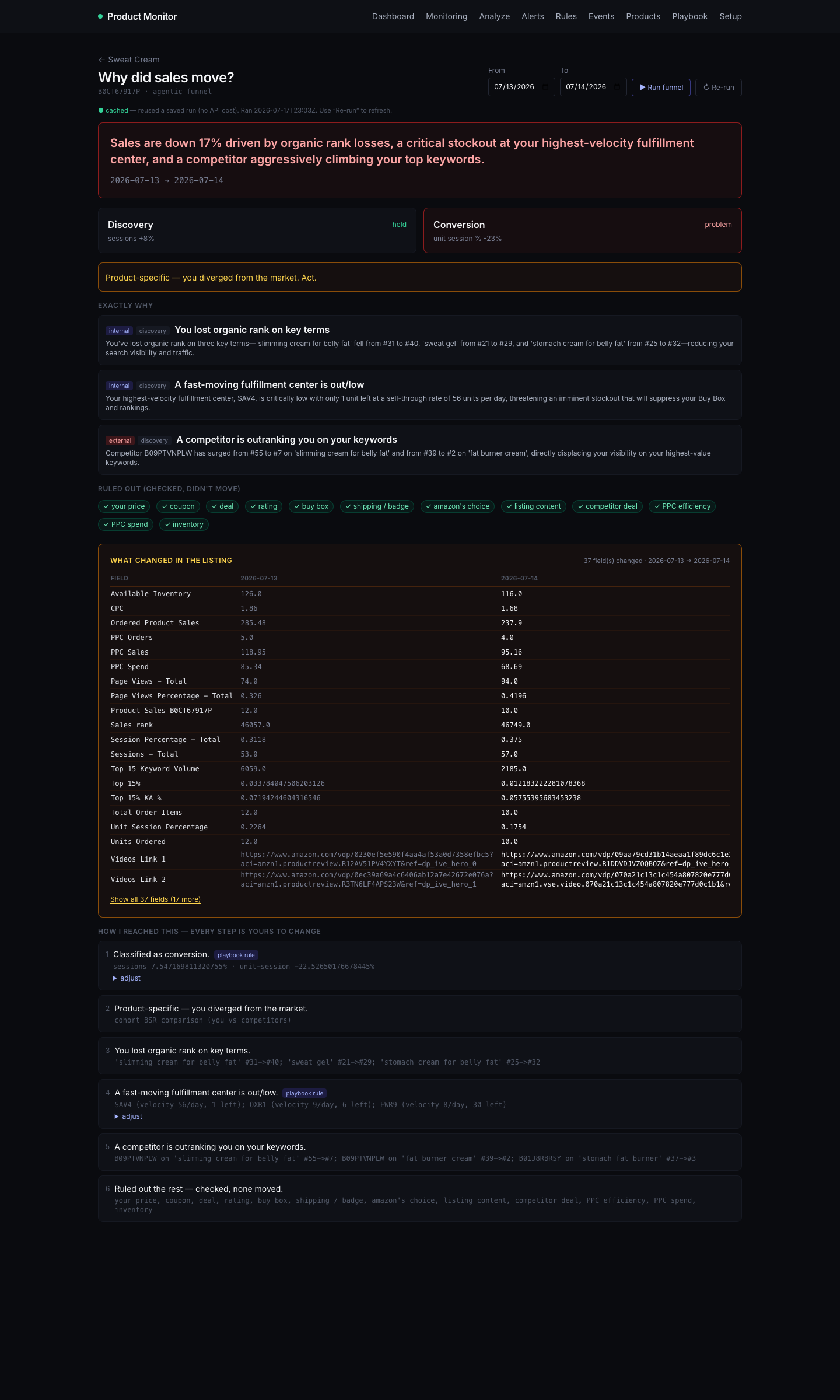
No black box. A deterministic engine checks every lever against your own history and your competitors — then plain language tells you what it found.
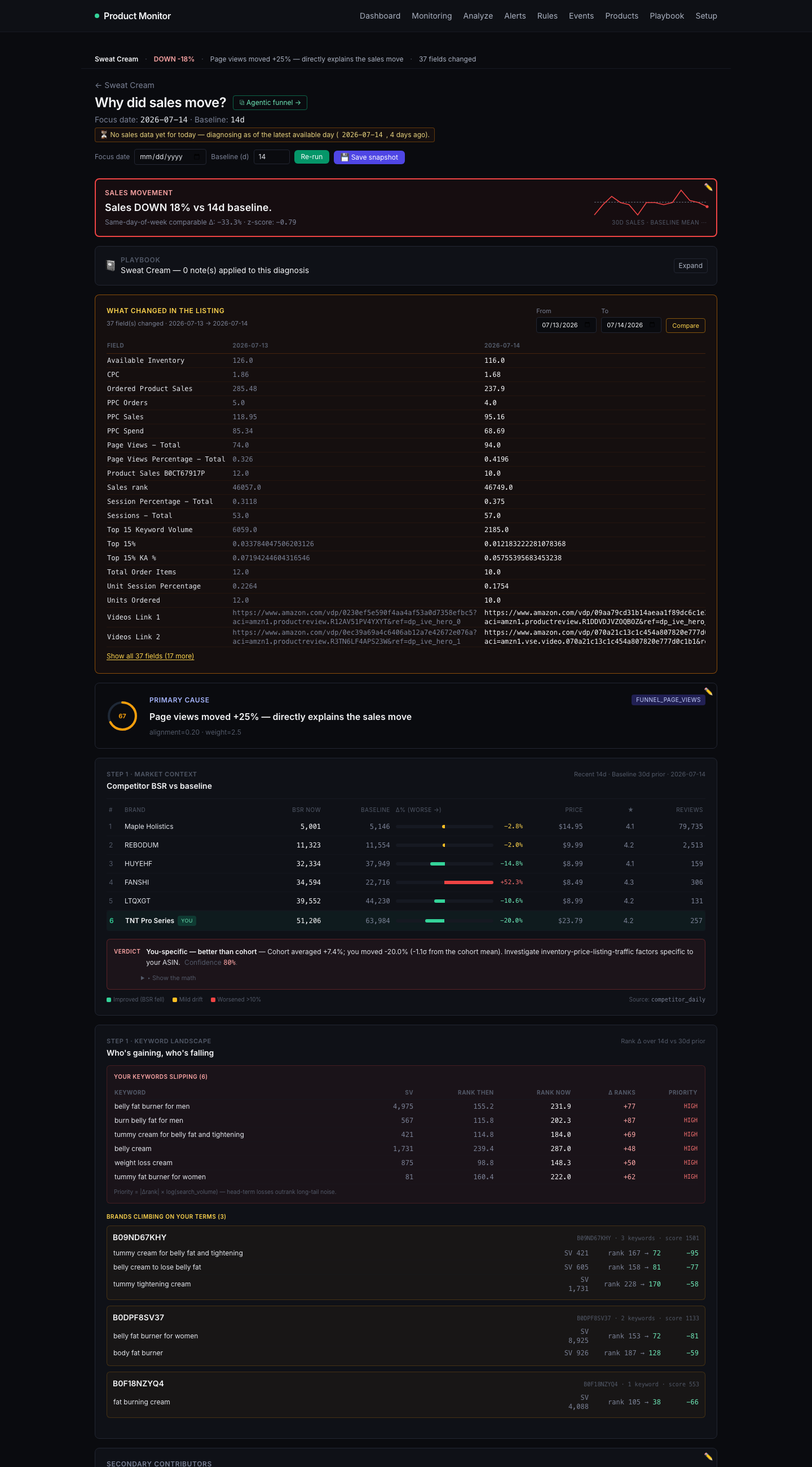
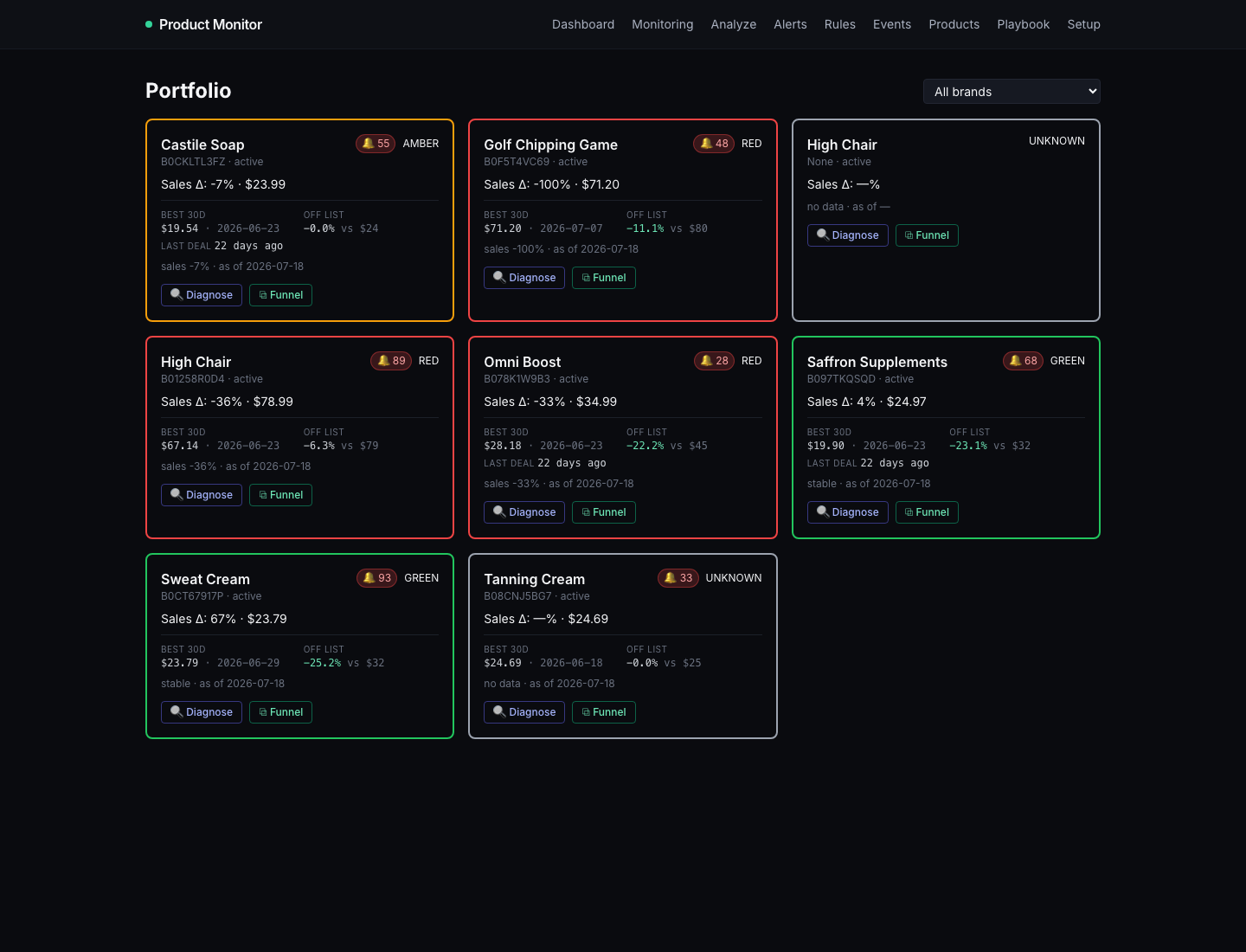
Sales, sessions, conversion, price, coupons, Buy Box, per-FC inventory, keyword ranks, competitor prices & BSR, and every listing field. Each value is checked against its own history first — bad data gets quarantined, never diagnosed.
Every move is classified discovery vs conversion, compared against your competitor cohort — market-wide noise means stand down, divergence means act — then drilled to the exact driver.
The exact cause with evidence, plus everything checked and ruled out. Disagree with any step? Correct it once — it's saved to your playbook and every future diagnosis uses it.
Ask anything in plain language. It pulls your sales, PPC, inventory, keyword and competitor data itself and answers with the numbers attached — while a human manager or VA is still opening the third dashboard. Hours of data-collection becomes one question.
Here is the full picture. There are 4 compounding problems killing your sales this week — and I can point to the exact data for each one.
🔴 Sales are down 37% vs your 14-day baseline ($909 vs $1,454 avg) — one week before Prime Day.
❌ Problem #1 — Your PPC has essentially died.
Impressions 2,873/day → 48/day (−98%) · PPC orders 7.9/day → 0 (−100%) · spend −91%.
No ads → no impressions → no sessions → no orders.
❌ Problem #2 — You're out of stock (0 days remaining). Amazon suppresses near-zero-inventory listings from organic and paid results — which is exactly why impressions cratered…
Every listing field is snapshotted daily and diffed — including the silent edits from Amazon's own AI systems. You see the exact field, before and after, same day.
Total inventory looks fine while your highest-velocity fulfillment center runs dry. Per-FC velocity detection warns before the Buy Box and rankings pay for it.
Who's climbing on the exact terms you're losing, who cut price, who launched a deal — tracked daily against your cohort.
If the whole cohort dropped, it tells you not to touch anything — the most expensive mistake is reacting to seasonal noise with price cuts and ad spend.
Every incoming value is validated against history; unit slips and entry errors are auto-repaired or withheld with a warning. Wrong inputs are how tools lie confidently.
Your thresholds, your seasonal patterns, your rules — corrections feed back into the engine, so it gets less generic and more yours every week.
Build detection flows across listing, sales and PPC: alert rules, daily briefings, and FC-velocity stockout warnings fire on the leading indicators — days before the damage shows up in your revenue graph.
Not just sales, TACoS and ACoS — the agent drills into which keywords make money and simultaneously checks their relevancy: search volume, your rank, and conversion, so you know if spend is chasing the wrong terms.